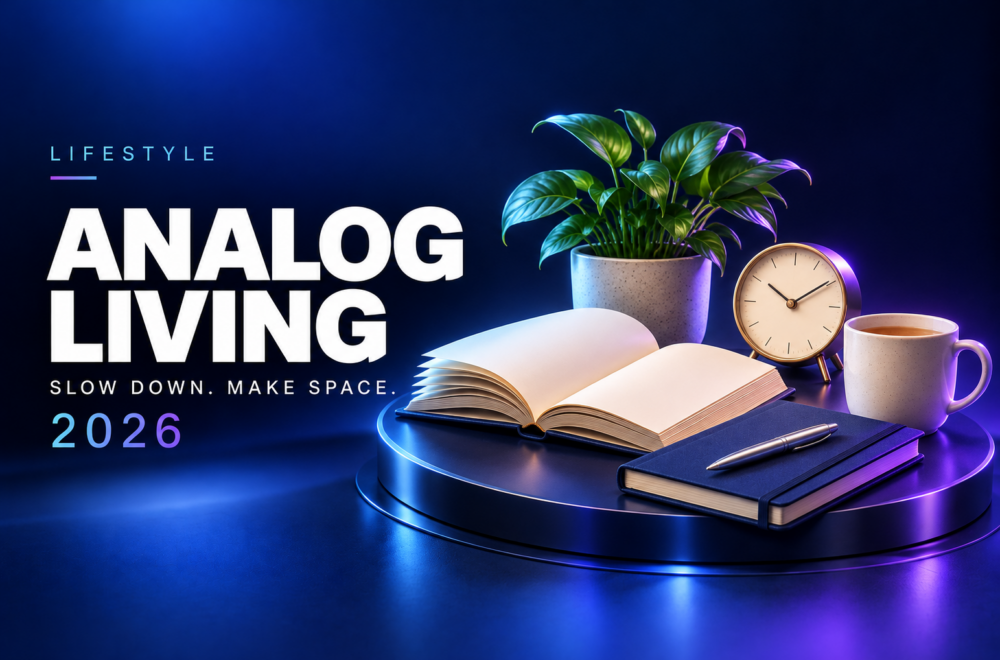
The book is on the shelf. The sketchbook is in a drawer. The unfinished puzzle is packed beneath something else. Meanwhile, the phone is within reach.
Sometimes the biggest obstacle to spending time offline is the difference between how easy each activity is to start.
That everyday imbalance helps explain the appeal of analog living, a lifestyle trend receiving attention throughout 2026. Its practical expression is simple: make more room for physical activities, familiar objects, and moments that do not revolve around a screen.
October reporting in the Financial Times examined households creating technology-free spaces, showing how this interest is influencing the way people arrange their homes.
You do not need a separate room or an elaborate collection of supplies to try it. A small change to one ordinary evening can be enough to discover what you enjoy.
What Is Analog Living?
In this context, analog living means deliberately including more tangible, offline activities in everyday life.
Reading a physical book, writing a letter, drawing, repairing clothing, or playing a board game can all fit. The common element is direct involvement in an activity that takes place away from an interactive screen.
A January 2026 CNN Business report republished by the University of California, Riverside described the movement as an effort to incorporate slower, more physical ways of completing tasks and finding entertainment. It also acknowledged the difficulty of measuring how widespread the phenomenon is.
That distinction matters. Analog living is a useful idea to experiment with, rather than a standard everyone must follow.
A paper planner may suit one person. Another may prefer digital organization while reserving drawing, reading, or gardening for leisure.
Why the Trend Has Continued Through 2026
Craft-industry data offers one indication of interest.
In its March 2026 Creativity Trend Report announcement, Michaels reported that searches for analog hobbies had increased 136% over the preceding six months. It also identified growing interest in activities such as journaling, needlecraft, and shared craft projects. These are retailer-reported findings, rather than a measure of everyone’s behavior.
By October, the conversation had also reached home design and fashion-industry coverage. Vogue Business examined the interest in making, mending, and craft communities, while the Financial Times explored technology-free areas in homes.
For an individual household, the useful question is more personal: which offline activity would you choose if starting it were as convenient as opening an app?
Start With a Small Setup
Choose one place where you already spend time. It could be the end of a sofa, a kitchen chair, a balcony table, or a small section of a desk.
Place one activity there, ready to use.
For reading, that might mean a book with a bookmark already inside. For drawing, leave a notebook and two pencils together. For a puzzle, use a tray that can be moved without dismantling the work.
Check the practical details. Is there enough light? Can you sit comfortably? Will the materials be in someone else’s way?
A useful setup should be easy to begin and easy to put away. If preparing the space becomes a project in itself, reduce the number of items.
There is no requirement to make the corner photograph beautifully. Its purpose is to help you use it.
An Ordinary Evening, Reimagined
The following example is a suggested routine, rather than a formula. Adjust the length and order around work, family responsibilities, and your preferences.
After Dinner: Choose Before You Sit Down
Decide what you want to do before settling into your usual spot.
“Read until the end of this chapter” gives the evening a clearer direction than “use my phone less.” So does “practice one drawing” or “sort the pieces around the puzzle’s edge.”
Keep the task small enough for the time available. A short activity you begin is more useful than an ambitious plan you repeatedly postpone.
If you need your phone for calls or household responsibilities, keep it available in a place that suits those needs. The aim is to make the chosen activity easier to continue.
During the Activity: Leave Room for Being a Beginner
Your handwriting may look untidy. A sketch may not resemble what you intended. The first few stitches may be uneven.
Treat those details as part of learning the activity.
You can choose a project with a modest finish line: fill half a page, practice a simple stitch on scrap fabric, or complete one section of a puzzle. That gives you somewhere to stop without demanding a polished result.
If you need instructions, read or watch them first, then try the task. Return to the guidance when you have a specific question.
Before You Finish: Prepare the Next Beginning
Use the last few minutes to make returning easy.
Mark the page. Put the pencil back beside the notebook. Keep the current puzzle pieces on their tray. Store loose materials together.
Then decide whether you actually enjoyed the activity.
You might want to repeat it tomorrow, try something else at the weekend, or leave it for another occasion. The experiment has still provided useful information.
Match the Activity to the Evening You Have
An activity that suits a free afternoon may feel impractical after a demanding workday.
Use the time and effort available as your starting point:
| What you have available | An activity to consider |
| A few spare minutes | Read a short passage or write a postcard |
| A quiet half-hour | Draw, journal, or work on a small puzzle |
| A shared evening | Play cards or try a familiar board game |
| Time to learn a skill | Practice a basic craft or clothing repair |
| A small outdoor space | Tend a plant or sketch something you observe |
These are options to test, rather than targets to complete.
Notice the kind of participation you prefer. Some people enjoy making an object, while others would rather read, listen to music, or have a conversation.
Let Technology Help You Get Started
Offline interests and online resources often work together.
For example, the Levi’s Wear Longer Project provides free digital resources and community-based learning focused on repairing, refreshing, and reimagining clothing. The initiative launched in January 2026.
You could use an instructional resource to understand a repair, then practice on a suitable item. Similarly, an online library catalog can help you find a physical book, and a digital calendar can reserve time for a local class.
Decide what you need from the resource before opening it. That makes it easier to recognize when you have enough information to begin.
Keep the First Experiment Inexpensive
Look through what you already own before buying equipment.
An unused notebook, ordinary pen, borrowed book, pack of cards, or leftover craft material may be enough to test your interest.
Choose supplies for a particular activity. A collection of attractive equipment does not tell you whether you will enjoy using it.
If an interest lasts, you can identify what would make the experience better. That might be improved lighting, a more comfortable tool, or guidance from someone experienced.
The purchase then responds to something you have learned about your preferences.
Make Shared Spaces Negotiable
In a shared home, agree on where materials can stay and when a common area is available.
A movable tray or small storage box may work better than leaving a project across the dining table. Invite others to join an activity without making participation compulsory.
A household can accommodate different forms of leisure. One person may read while another watches a film, with a shared game saved for a time everyone chooses.
The arrangement should make ordinary evenings easier to enjoy.
Find the Routine You Want to Return To
After a few attempts, ask three questions: Did I enjoy the activity? Was it easy to start? What would I change next time?
Perhaps the book stays, the elaborate craft kit goes away, and a pack of cards earns a place on the table.
That is a workable expression of analog living: a home and routine arranged around activities you value, with enough space to pick them up again.