
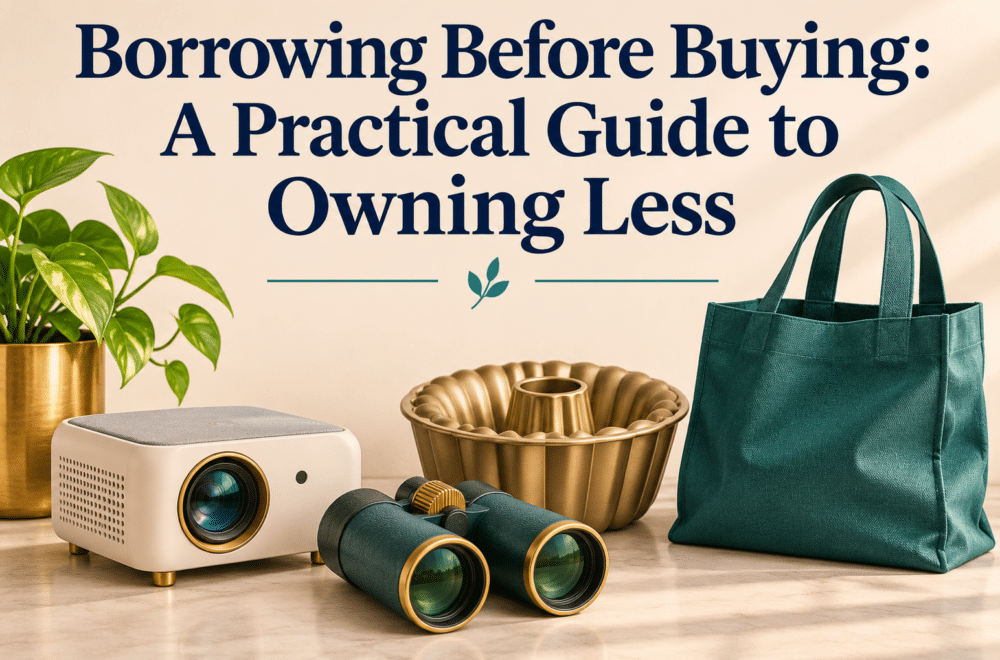
The projector seemed like a good purchase.
There was a planned movie night, an empty wall, and a convincing picture on the product page. Months later, the projector occupied a closet shelf beside a specialty cake pan and equipment for a hobby that never became a habit.
None of those purchases was necessarily foolish. Each solved a real problem at the time.
The question is whether ownership was the best way to solve it.
Borrowing before buying introduces a pause between wanting an experience and acquiring the equipment attached to it. That pause can save money and storage space, but its value depends on how practical borrowing is for the life you actually lead.
Buy the use, then consider the object
A useful starting sentence is: “I need this item to…”
Finish it with a specific activity.
“I need binoculars for a weekend bird-watching trip” describes a limited requirement. “I need binoculars because I want to become someone who spends more time outdoors” combines an equipment decision with a larger personal hope.
The second thought is understandable, but it deserves a trial before a purchase.
Borrowing can separate interest from commitment. You may discover that you enjoy the activity, that a different model would suit you better, or that the equipment spends most of the day in a bag.
The Environmental Protection Agency’s guidance on shopping decisions suggests borrowing, renting, or sharing items used infrequently, including tools and party supplies.
That principle does not require a minimalist identity. It simply asks whether repeated ownership benefits exist beyond the immediate occasion.
The closet test
Before purchasing an occasional-use item, decide exactly where it will live.
Measure the space if necessary. Include its case, attachments, charger, and any supplies it requires.
Then imagine retrieving it six months later. Will the parts still be together? Will you remember how it works? Will it need cleaning, charging, maintenance, or an accessory you no longer have?
Ownership includes those small future jobs.
This does not make owning things undesirable. A frequently used item can earn its place easily. The closet test is most useful when the planned use is rare and the storage commitment is permanent.
It can also reveal a simpler option. A decorative pan may produce the desired cake, but an ordinary pan you already own may support a different design with less preparation.
Ask whether you need the object, access to the object, or merely the result it helps produce.
Access may already exist nearby
Public libraries sometimes lend more than books.
For example, Nashville Public Library’s Library of Things includes categories such as tools, electronics, musical instruments, and food or party items. Its published page describes free borrowing for up to three weeks.
That is a local example, not a promise about every library. Collections, eligibility, availability, and loan conditions differ.
Search your own library’s catalog and service pages before assuming an item is available. Community lending organizations and commercial rental services may offer other options.
Check the complete arrangement:
- Who is eligible to borrow?
- Can the item be reserved for the required dates?
- Where must it be collected and returned?
- Are accessories included?
- What cleaning or inspection is required?
- What happens if something is damaged or late?
A free loan can still require transport and planning. Those requirements belong in the decision.
Compare the full trip, not just the fee
Imagine a fictional item that costs $90 to buy.
A rental costs a hypothetical $18, and transport adds $8. The immediate rental outlay is $26.
For a single use, that comparison may favor renting. If you need the item repeatedly, the result can change.
However, avoid turning the calculation into a prediction based on imagined enthusiasm. “I could use it every weekend” is different from having a regular activity already scheduled.
Include the less visible costs: pickup time, return travel, required supplies, storage, maintenance, and the inconvenience of an unavailable item.
Also consider the consequence of failure. A flexible personal experiment can tolerate a canceled reservation more easily than an event with a fixed deadline.
Borrowing works best when its practical demands fit the occasion.
A useful decision note
I need the item for one planned activity. I can obtain it on time, understand the return conditions, and have included the transport and preparation costs.
If that statement is difficult to complete, investigate further before relying on the arrangement.
Borrowing from a friend needs its own clarity
Personal borrowing can feel informal until an accessory goes missing or the owner needs the item back sooner than expected.
Agree on the return date before taking it home. Confirm which parts are included and ask about any operating or cleaning instructions.
For an expensive or delicate item, discuss what would happen if it were damaged. If that conversation feels too uncomfortable, a commercial rental or a different plan may be easier on the relationship.
Return the item as agreed and report problems promptly. Do not make the owner investigate an unexplained malfunction later.
A reliable borrower reduces the work created for the person lending.
Sometimes the trial supports buying
After borrowing an item, ask a better question than “Did I like it?”
Ask whether you used it enough, whether its limitations mattered, and whether dependable access would improve an established routine.
A borrowed instrument may confirm sustained interest. A projector may become central to regular gatherings. A specialty kitchen tool may prove useful far beyond the first recipe.
Those experiences provide a more concrete basis for ownership.
You can now choose features based on use rather than speculation. You may also decide that a simpler item is sufficient.
The next time a purchase seems inevitable, write the activity on a calendar before placing the object in a cart. Arrange access, use the item, and notice what happens afterward.
If you still want to own it, you will have a clearer reason—and a place prepared for it.